
Report Submitted to the Research Experience for
Undergraduates Program at the
Title: Gas Dilution System
Name:
Level: Senior
Number of semesters participated: 1
Date of submission:
Advisor: Dr. Venkat Bhethanabotla
Department: Chemical Engineering
This report has been approved:_________________________________Date:________
(Advisor
signature)
Report can be published on the REU website: YES/NO
Abstract: This
paper describes the equipment design needed to generate and detect low
concentration organic vapors with sensors.
Sensor capababilities, such as sensitivity,
selectivity, and response time, must be quantified. The vapor dilution system provides a means of
testing these parameters by introducing chemical vapors to the sensor.
Introduction
Sensitive, selective and fast
responding sensors were developed; however, these parameters need to tested and
quantified for various organic vapors at low concentrations. This requires some equipment that will
generate vapors in known concentrations.
The equipment should be fully automated and capable of taking continuous
recordings of temperature and concentration.
Additionally, it should automatically select one or more of the various
organic liquid sources for vapor generation and testing. The former
requirements specify a dynamic gas dilution system.
Theory
Procedures for production of
mixtures of vapors at precise concentrations are much more difficult than for
liquids. Gasses, unlike liquids, cannot
be easily weighed; gas volumes may change during handling, and temperature and
pressure effects must be considered. Two
methods of preparing mixtures of gases can be classified as static or dynamic. Static methods are used for small volumes,
high concentrations, and tolerable losses of gases to wall containers. Dynamic methods are used for continuous vapor
flows, large volumes, and negligible losses to wall containers. From the various dynamic methods available,
the evaporative method is widely used.
Dynamic evaporative methods are sensitive to the depth, the vapor
pressure, and the temperature of the liquid.
In the present design, there will be three streams: The carrier stream
(Qs), and the dilutant streams (Q1 and Q2). The following equations apply to the chosen
evaporative method:
CONCENTRATION (Ci):
1. Ci = (Yi*Qs)/(Qs+Q1+Q2)
MOLE FRACTION (Yi):
2. Yi=Pvp/PT
VAPOR PRESSURE (Pvp):
Antoine Equation:
3. ln(Pvp)=VPA-(VPB/(T+VPC))
OR
Wagner Equation:
4. ln(Pvp/Pc)=((1-x)^-1)*(
VPA*x+VPB*x^1.5 +VPC*x^3+VPD*x^6)
Ci =
Organic Concentration
Yi= Mole fraction
Qs= Carrier Gas Flow Stream (ccm)
Q1= Dilutant Flow Stream (ccm)
Q2= Dilutant Flow Stream (ccm)
Pvp= Organic
Vapor Pressure (bars)
PT= Total Pressure (bars)
T= Temperature (K)
The above equations were used to calculate
theoretical concentrations for various organic vapors. The results of these
calculations are presented in Table 1 and Table 2 of the appendix. Equation one
assumes that the mass of the vapor collected is negligible. Organic chemicals
were chosen so that they will exist as liquids at operating temperature.
Another set of equations were developed to account for the volume of the vapors
generated. A Matlab program was developed to
calculate the theoretical concentrations and ppm
levels possible for five of the organic chemicals. The programs are given in
the appendix.
System Design and Dilution Method
Figure 1 shows the gas dilution system
design and method chosen. Electrical
connectivity and signal lines are omitted for clarity. The flow of the carrier
gas starting at MFC 1 (mass flow controller) is described below:
Carrier
gas (nitrogen or hydrogen) is delivered through ¼ ”
stainless steel tubing to bubbler units containing organic liquids. Due to the kinetic nature of the sensor
response, gas flow control is very important; consequently, the gas flow rate
is regulated with MKS mass flow controllers. The selection of the bubbler unit
is controlled by solenoid valves, which in turn are controlled with a Labview program. The
carrier gas is bubbled through the organic liquid. At the outlet of the bubbler
there is a teflon tube which
carries the vapor through another solenoid valve to a T-junction. The carrier gas is then further diluted to
the desired concentrations and sent to a SAW.
Figure 1: Dilution Apparatus
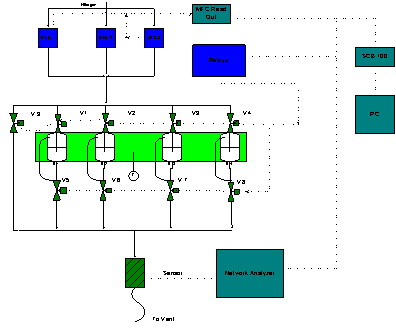
Figure 1: Inert carrier gas (Qs), from MFC 1,
collects organic vapor from E1-E4. The carrier gas flow to the bubbler is
regulated by solenoids (V1-V8), connected to a digital acquisition card. By pass (P#) allows for flushing the lines.
MFC 2 (Q2) and MFC 3 (Q3) regulate the dilutant
streams. Diluted gas goes to SAW sensor
for testing. Temperature (T) and pressure (P) are maintained at desired values.
Different organic liquids are
contained in E1 to E4. If a single
bubbler is chosen (E1), its corresponding solenoid valves (V1, V5) must be
switched from normally closed to open.
At the same time the remaining valves (V2-V4, V6- V9) should remain
closed to contain the other organic liquids.
The system must avoid intermixing components from different bubblers;
however, intermixing is allowed if more than one bubbler is chosen. This system design allows for the sensor to have
a supply of either one low concentration component or a mixture of
components. To achieve this objective
the solenoid valves are connected to Omega solid state relays. This is connected to a National Instruments
digital acquisition card and a PC with Labview
software for continuous measurement and automatic control. The valve V-9 acts
as a bypass to flush the system, and is activated prior to selecting a
different organic vapor. This allows the
clean carrier gas to clean the entire system of any previously selected
chemical.
The most important objective of
the gas dilution system is to generate a stream containing low concentration
organics. To achieve this requires
proper design of the bubbler units E1 to E4. Dynamic systems with appreciable
vapor pressures can produce concentrations close to saturated vapor pressures
by bubbling the carrier gas through the organic
liquid. For low boiling liquids, a
single tube is sufficient. A fritted
disk is fitted to the end of the tube to aid in vapor generation. The
temperature of the bubbler units is maintained by housing the bubblers in a
water bath.
Pending Conclusion
The success of the above gas
dilution system design is yet to be determined.
High frequency polymer coated
quart crystal microbalances will be used as the test sensor for calibrating the
equipment.
References
- J. W. Grate, David S. Ballantine
Jr., Hank Wohltjen, An
Automated Vapor Generation and Data Collection Instrument for the
Evaluation of Chemical Microsensors. Sensors and Actuators, 11 (1987)
173-188.
- R. S. Barratt, The
preparation of standard gas mixtures: a review, Analyst (
- J. W. Grate, Mark Klusty,
Vapor Stream Dilution by Pulse Width Modulation, Naval Research Laboratory
Memorandum Report 6762, Dec. 11, 1990.
- Michael Thompson, David C. Stone,
Surface-Launched Acoustic Wave Sensors: Chemical Sensing and Thin Film
Characterization. Chemical Analysis: A series of monographs on analytic
chemistry and its applications. 144.
APPENDIX
|
TABLE
1: Theoretical Concentrations |
|
|
|
|
|
|
Q1=90 |
Q1=80 |
Q1=70 |
Q1=60 |
Q1=50 |
|
ORGANIC |
Name |
P(mmHg) |
Yi |
Ci |
Ci |
Ci |
Ci |
Ci |
|
BENZENE |
A |
182.44124 |
0.24005 |
0.0240054 |
0.025269 |
0.026673 |
0.028242 |
0.030007 |
|
CYCLOHEXANE |
B |
185.071729 |
0.24352 |
0.0243515 |
0.025633 |
0.027057 |
0.028649 |
0.030439 |
|
PENTANE |
C |
866.084717 |
1.13959 |
0.1139585 |
0.119956 |
0.126621 |
0.134069 |
0.142448 |
|
OCTANE |
D |
43.5588864 |
0.05731 |
0.0057314 |
0.006033 |
0.006368 |
0.006743 |
0.007164 |
|
HEXANE |
E |
279.38273 |
0.36761 |
0.0367609 |
0.038696 |
0.040845 |
0.043248 |
0.045951 |
|
ACETONE |
F |
424.953222 |
0.55915 |
0.0559149 |
0.058858 |
0.062128 |
0.065782 |
0.069894 |
|
ETHANONL |
G |
134.448854 |
0.17691 |
0.0176906 |
0.018622 |
0.019656 |
0.020813 |
0.022113 |
|
ETHYLBENZENE |
H |
21.5433506 |
0.02835 |
0.0028347 |
0.002984 |
0.00315 |
0.003335 |
0.003543 |
|
CHLOROBENZENE |
I |
26.0569397 |
0.03429 |
0.0034285 |
0.003609 |
0.003809 |
0.004034 |
0.004286 |
|
CYCLOPENTANE |
J |
553.702471 |
0.72856 |
0.0728556 |
0.07669 |
0.080951 |
0.085712 |
0.091069 |
|
N-DECANE |
K |
3.70803583 |
0.00488 |
0.0004879 |
0.000514 |
0.000542 |
0.000574 |
0.00061 |
|
N-HEPTANE |
L |
92.2720216 |
0.12141 |
0.0121411 |
0.01278 |
0.01349 |
0.014284 |
0.015176 |
|
METHANOL |
M |
266.178964 |
0.35024 |
0.0350235 |
0.036867 |
0.038915 |
0.041204 |
0.043779 |
|
ISOPROPYL ALCOHOL |
N |
104.855602 |
0.13797 |
0.0137968 |
0.014523 |
0.01533 |
0.016232 |
0.017246 |
|
PROPANOL |
O |
52.5791695 |
0.0776 |
0.0069183 |
0.007282 |
0.007687 |
0.008139 |
0.008648 |
|
TOULENE |
P |
58.9770618 |
0.06918 |
0.0077601 |
0.008169 |
0.008622 |
0.00913 |
0.0097 |
|
NPROPYL BENZENE |
Q |
8.40295772 |
0.01106 |
0.0011057 |
0.001164 |
0.001229 |
0.001301 |
0.001382 |
|
BENZALDEHYDE |
R |
3.1239658 |
0.00411 |
0.000411 |
0.000433 |
0.000457 |
0.000484 |
0.000514 |
|
ETHYLENE GLYCOL |
S |
0.41165456 |
0.00054 |
5.417E-05 |
5.7E-05 |
6.02E-05 |
6.37E-05 |
6.77E-05 |
|
GLYCEROL |
T |
0.0001658 |
2.2E-07 |
2.18E-08 |
2.30E-08 |
2.42E-08 |
2.57E-08 |
2.73E-08 |
|
METHYL ETHYL KETONE |
U |
176.845009 |
0.23269 |
0.0232691 |
0.024494 |
0.025855 |
0.027375 |
0.029086 |
OPERATING CONDITIONS
|
TOTAL
PRESSURE (mmHg) |
760 |
|
CARRIER
GAS (CCM) |
20 |
|
DILUTANT
Q1 (CCM) |
VARIANT |
|
DILUTANT
Q2 (CCM) |
90 |
|
TEMPERATURE
(K) |
313.15 |
Table 1: The theoretical concentrations and vapor
pressures were calculated from Equations 1 to 4 for twenty common
organics. The results show that very low
concentrations will be produced with two dilutant
streams and one carrier gas stream. The vapor pressure of Pentane, C, is above
the total pressure, therefore, it will not be used to
generate a vapor. Also, note glycerol’s
low vapor pressure.
TABLE 2: Theoretical Concentrations
|
|
|
|
Q2=80 |
Q2=70 |
Q2=60 |
Q2=50 |
Q2=40 |
Q2=30 |
|
ORGANIC |
Name |
P(mmHg) |
Ci |
Ci |
Ci |
Ci |
Ci |
Ci |
|
BENZENE |
A |
182.44124 |
0.0480109 |
0.053345 |
0.060014 |
0.06859 |
0.080018088 |
0.096021705 |
|
CYCLOHEXANE |
B |
185.07173 |
0.0487031 |
0.054115 |
0.060879 |
0.06958 |
0.081171811 |
0.097406173 |
|
PENTANE |
C |
866.08472 |
0.227917 |
0.253241 |
0.284896 |
0.3256 |
0.379861718 |
0.455834062 |
|
OCTANE |
D |
43.558886 |
0.0114629 |
0.012737 |
0.014329 |
0.01638 |
0.019104775 |
0.02292573 |
|
HEXANE |
E |
279.38273 |
0.0735218 |
0.081691 |
0.091902 |
0.10503 |
0.122536285 |
0.147043542 |
|
ACETONE |
F |
424.95322 |
0.1118298 |
0.124255 |
0.139787 |
0.15976 |
0.186382992 |
0.223659591 |
|
ETHANONL |
G |
134.44885 |
0.0353813 |
0.039313 |
0.044227 |
0.05054 |
0.058968796 |
0.070762555 |
|
ETHYLBENZENE |
H |
21.543351 |
0.0056693 |
0.006299 |
0.007087 |
0.0081 |
0.009448838 |
0.011338606 |
|
CHLOROBENZENE |
I |
26.05694 |
0.0068571 |
0.007619 |
0.008571 |
0.0098 |
0.011428482 |
0.013714179 |
|
CYCLOPENTANE |
J |
553.70247 |
0.1457112 |
0.161901 |
0.182139 |
0.20816 |
0.242851961 |
0.291422353 |
|
N-DECANE |
K |
3.7080358 |
0.0009758 |
0.001084 |
0.00122 |
0.00139 |
0.001626332 |
0.001951598 |
|
N-HEPTANE |
L |
92.272022 |
0.0242821 |
0.02698 |
0.030353 |
0.03469 |
0.040470185 |
0.048564222 |
|
METHANOL |
M |
266.17896 |
0.0700471 |
0.07783 |
0.087559 |
0.10007 |
0.11674516 |
0.140094192 |
|
ISOPROPYL ALCOHOL |
N |
104.8556 |
0.0275936 |
0.03066 |
0.034492 |
0.03942 |
0.045989299 |
0.055187159 |
|
PROPANOL |
O |
52.57917 |
0.0138366 |
0.015374 |
0.017296 |
0.01977 |
0.023061039 |
0.027673247 |
|
TOULENE |
P |
58.977062 |
0.0155203 |
0.017245 |
0.0194 |
0.02217 |
0.025867132 |
0.031040559 |
|
NPROPYL BENZENE |
Q |
8.4029577 |
0.0022113 |
0.002457 |
0.002764 |
0.00316 |
0.003685508 |
0.004422609 |
|
BENZALDEHYDE |
R |
3.1239658 |
0.0008221 |
0.000913 |
0.001028 |
0.00117 |
0.00137016 |
0.001644193 |
|
ETHYLENE GLYCOL |
S |
0.4116546 |
0.0001083 |
0.00012 |
0.000135 |
0.00015 |
0.00018055 |
0.00021666 |
|
GLYCEROL |
T |
0.0001658 |
4.36E-08 |
4.85E-08 |
5.45E-08 |
6.23E- 08 |
7.27E-08 |
8.73E-08 |
|
METHYL ETHYL KETONE |
U |
176.84501 |
0.0465382 |
0.051709 |
0.058173 |
0.06648 |
0.0775636 |
0.09307632 |
OPERATING CONDITIONS
|
TOTAL
PRESSURE (mmHg) |
760 |
|
CARRIER
GAS (CCM) |
20 |
|
DILUTANT
Q1 (CCM) |
0 |
|
DILUTANT
Q2 (CCM) |
VARIANT |
|
TEMPERATURE
(K) |
313.15 |
Table 2: The effect of using only dilutant is considered in this set of calculations. The
results show that low concentrations can still be achieved with only one dilutant stream. Antoine
and Wagner equation constants were obtained from The Properties of Gases and
Liquids, Fourth Ed.
PROGRAM 1: Used to calculate theoretical pmm levels possible for benzene, cyclohexane,
n-hexane, toluene, and dichloromethane. Program accounts for volume of vapor
generated in bubblers.
selection % Calls menu
if x==0
disp('Program
Terminated')
end
if x==1
%Benzene Constants
VPA=-6.96009;
VPB=1.31328;
VPC=-2.75683;
VPD=-2.45491;
Tc=553.5; % K
Pc=40.7; %
bar
R=83.14; %
bar*cm^3*mol^-1*K^-1
MW=79.114; % Molecular Wt.
T=input('Enter BubblerTemperature:
')
PT=1.01325; %Operating Pressure, bar
%Antoine
%lnPvp_A=VPA-(VPB/(T+VPC))
%Pvp_A=exp(lnPvp_A)*760
%y=Pvp_A/PT
%Wagner
x=1-T/Tc;
Psat_sol=exp( ((1-x)^-1)*( VPA*x+VPB*x^1.5
+VPC*x^3+VPD*x^6 ) )*Pc; % bar
ys=Psat_sol/PT %
Fraction of undiluted vapor
Qc=input('Enter initial
Carrier Gas, SCCM: '); % Carrier
Flow, SCCM
Q1=input('Enter Dilutant 1 flow, SCCM (Dilutant 2
= 2*Dilutant1): '); % Dilutant 1, SCCM
Q2=2.*Q1; % Dilutant 2, SCCM
Qs=(ys.*Qc)./(1-ys) % Volume of Vapor generated from
bubbler, cm^3/min
% by volumetric
fraction equal to mole fraction
Qcs=Qc+Qs % volume of carrier gas
and solvent vapor, cm^3/min
yds=Qs./(Qcs+Q1+Q2) % Fraction of diluted vapor
Cmixt=Psat_sol./(R.*T*(1/100^3)
) % Mixture concentration,
mol/m^3
Cds=yds.*Cmixt % Concentration
of diluted mixture, mol/m^3
Cds_mg=Cds.*MW*1000 % Concentration
diluted mixture, mg/m^3
PPM_vv=(Qs./(Qcs+Q1+Q2))*(10^6) % Parts per million, by volume
selection
end
if x==2
%Toulene Constants
VPA=-7.28607;
VPB=1.38091;
VPC=-2.83433;
VPD=-2.79168;
Tc=591.8;
Pc=41;
R=83.14;
% bar*cm^3*mol^-1*K^-1
MW=92.141;
% Molecular Wt.
Tfp=178; % Freezing Pt, K
Tb=383.8;
% Boiling Pt, K
T=input('Enter BubblerTemperature:
')
PT=1.01325; %Operating Pressure, bar
%Antoine
%lnPvp_A=VPA-(VPB/(T+VPC))
%Pvp_A=exp(lnPvp_A)*760
%y=Pvp_A/PT
%Wagner
x=1-T/Tc;
Psat_sol=exp( ((1-x)^-1)*( VPA*x+VPB*x^1.5
+VPC*x^3+VPD*x^6 ) )*Pc; % bar
ys=Psat_sol/PT %
Fraction of undiluted vapor
Qc=input('Enter initial
Carrier Gas, SCCM: '); % Carrier
Flow, SCCM
Q1=input('Enter Dilutant 1 initial flow, SCCM: '); % Dilutant 1, SCCM
Q2=2.*Q1; % Dilutant 2, SCCM
Qs=(ys.*Qc)./(1-ys) % Volume of Vapor generated from
bubbler, cm^3/min
% by volumetric
fraction equal to mole fraction
Qcs=Qc+Qs % volume of carrier gas and solvent vapor,
cm^3/min
yds=Qs./(Qcs+Q1+Q2) % Fraction of diluted vapor
Cmixt=Psat_sol./(R.*T*(1/100^3)
) % Mixture concentration,
mol/m^3
Cds=yds.*Cmixt % Concentration
of diluted mixture, mol/m^3
Cds_mg=Cds.*MW*1000 % Concentration
diluted mixture, mg/m^3
PPM_vv=(Qs./(Qcs+Q1+Q2))*(10^6) % Parts per million, by volume
selection
end
if x==3
% Cyclohexane
VPA=-6.96009;
VPB=1.31328;
VPC=-2.75683;
VPD=-2.45491;
Tc=553.5;
Pc=40.7;
R=83.14;
% bar*cm^3*mol^-1*K^-1
MW=82.146;
% Molecular Wt.
Tfp=169.7; % Freezing Pt, K
Tb=356.1;
% Boiling Pt, K
T=input('Enter BubblerTemperature:
')
PT=1.01325; %Operating Pressure, bar
%Antoine
%lnPvp_A=VPA-(VPB/(T+VPC))
%Pvp_A=exp(lnPvp_A)*760
%y=Pvp_A/PT
%Wagner
x=1-T/Tc;
Psat_sol=exp( ((1-x)^-1)*( VPA*x+VPB*x^1.5
+VPC*x^3+VPD*x^6 ) )*Pc; % bar
ys=Psat_sol/PT %
Fraction of undiluted vapor
Qc=input('Enter initial
Carrier Gas SCCM: '); % Carrier
Flow, SCCM
Q1=input('Enter Dilutant 1 initial flow, SCCM: '); % Dilutant 1, SCCM
Q2=2.*Q1; % Dilutant
2, SCCM
Qs=(ys.*Qc)./(1-ys) % Volume of Vapor generated from
bubbler, cm^3/min
% by volumetric
fraction equal to mole fraction
Qcs=Qc+Qs % volume of carrier gas
and solvent vapor, cm^3/min
yds=Qs./(Qcs+Q1+Q2) % Fraction of diluted vapor
Cmixt=Psat_sol./(R.*T*(1/100^3)
) % Mixture concentration,
mol/m^3
Cds=yds.*Cmixt % Concentration
of diluted mixture, mol/m^3
Cds_mg=Cds.*MW*1000 % Concentration
diluted mixture, mg/m^3
PPM_vv=(Qs./(Qcs+Q1+Q2))*(10^6) % Parts per million, by volume
selection
end
if x==4
%n-Hexane Constants
VPA=-7.46765;
VPB=1.44211;
VPC=-3.28222;
VPD=-2.50941;
Tc=507.5;
Pc=30.1;
R=83.14; %
bar*cm^3*mol^-1*K^-1
MW=86.178; % Molecular Wt.
Tfp=177.8; %
Freezing Pt, K
Tb=341.9; %
Boiling Pt, K
T=input('Enter BubblerTemperature:
')
PT=1.01325; %Operating Pressure, bar
%Antoine
%lnPvp_A=VPA-(VPB/(T+VPC))
%Pvp_A=exp(lnPvp_A)*760
%y=Pvp_A/PT
%Wagner
x=1-T/Tc;
Psat_sol=exp( ((1-x)^-1)*( VPA*x+VPB*x^1.5
+VPC*x^3+VPD*x^6 ) )*Pc; % bar
ys=Psat_sol/PT %
Fraction of undiluted vapor
Qc=input('Enter initial
Carrier Gas SCCM: '); % Carrier
Flow, SCCM
Q1=input('Enter Dilutant 1 initial flow, SCCM: '); % Dilutant 1, SCCM
Q2=2.*Q1; % Dilutant 2, SCCM
Qs=(ys.*Qc)./(1-ys) % Volume of Vapor generated from
bubbler, cm^3/min
% by volumetric
fraction equal to mole fraction
Qcs=Qc+Qs % volume of carrier gas
and solvent vapor, cm^3/min
yds=Qs./(Qcs+Q1+Q2) % Fraction of diluted vapor
Cmixt=Psat_sol./(R.*T*(1/100^3)
) % Mixture concentration,
mol/m^3
Cds=yds.*Cmixt % Concentration
of diluted mixture, mol/m^3
Cds_mg=Cds.*MW*1000 % Concentration
diluted mixture, mg/m^3
PPM_vv=(Qs./(Qcs+Q1+Q2))*(10^6) % Parts per million, by volume
selection
end
if x==5
% dichloromethane Constants
VPA=-7.35739;
VPB=2.17546;
VPC=-4.07038;
VPD=3.50701;
Tc=510;
Pc=63;
R=83.14;
% bar*cm^3*mol^-1*K^-1
MW=84.933;
% Molecular Wt.
Tfp=178.1; % Freezing Pt, K
Tb=313.0;
% Boiling Pt, K
%Operate (263 to 303 K, or -10 to 303 K)
T=input('Enter BubblerTemperature:
')
PT=1.01325; %Operating Pressure, bar
%Antoine
%lnPvp_A=VPA-(VPB/(T+VPC))
%Pvp_A=exp(lnPvp_A)*760
%y=Pvp_A/PT
%Wagner
x=1-T/Tc;
Psat_sol=exp( ((1-x)^-1)*( VPA*x+VPB*x^1.5
+VPC*x^3+VPD*x^6 ) )*Pc; % bar
ys=Psat_sol/PT %
Fraction of undiluted vapor
Qc=input('Enter initial
Carrier Gas SCCM: '); % Carrier
Flow, SCCM
Q1=input('Enter Dilutant 1 initial flow, SCCM: '); % Dilutant 1, SCCM
Q2=2.*Q1; % Dilutant 2, SCCM
Qs=(ys.*Qc)./(1-ys) % Volume of Vapor generated from
bubbler, cm^3/min
% by volumetric
fraction equal to mole fraction
Qcs=Qc+Qs % volume of carrier gas
and solvent vapor, cm^3/min
yds=Qs./(Qcs+Q1+Q2) % Fraction of diluted vapor
Cmixt=Psat_sol./(R.*T*(1/100^3)
) % Mixture concentration,
mol/m^3
Cds=yds.*Cmixt % Concentration
of diluted mixture, mol/m^3
Cds_mg=Cds.*MW*1000 % Concentration diluted
mixture, mg/m^3
PPM_vv=(Qs./(Qcs+Q1+Q2))*(10^6) % Parts per million, by volume
selection
end